This scene, a 3-second handrail slide that's made to last 10 seconds — because that's how long it takes to really appreciate it — is probably my favorite in all of João Pedro Rodrigues' work.
Showing posts with label João Pedro Rodrigues. Show all posts
Showing posts with label João Pedro Rodrigues. Show all posts
Sunday, January 20, 2013
China, China (João Pedro Rodrigues e João Rui Guerra da Mata, 2007)
Trapped in a life she doesn't want, China finds her freedom in small moments of bliss she invents for herself, and in those moments, China, China comes alive like few other movies do.
This scene, a 3-second handrail slide that's made to last 10 seconds — because that's how long it takes to really appreciate it — is probably my favorite in all of João Pedro Rodrigues' work.
This scene, a 3-second handrail slide that's made to last 10 seconds — because that's how long it takes to really appreciate it — is probably my favorite in all of João Pedro Rodrigues' work.


Sunday, December 23, 2012
Viagem à Expo (João Pedro Rodrigues, 1998)
Viagem à Expo is a sort of follow-up to Esta é a Minha Casa, this time following the Fundo family on a trip to Lisbon, to visit the 1998 Lisbon World Exposition (Expo '98).
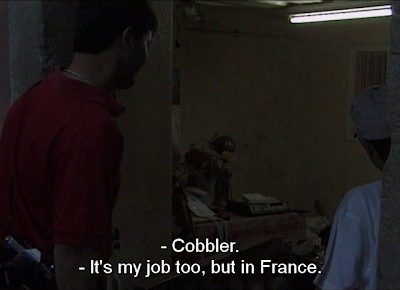
After getting to know the family in their natural environment(s) — in France and Trás-os-Montes — we now get to see them in the role of "tourists". Because the subjects of the film are now, for the most part, passive (walking, watching, learning), this was never going to be as interesting as the first film was, and for that reason also, it is unsurprising to find that the best scenes are the ones in which they are "allowed" to fall back into familiar territory (a chance encounter between José and a fellow cobbler, and a devotion-filled visit to a religious giftshop).
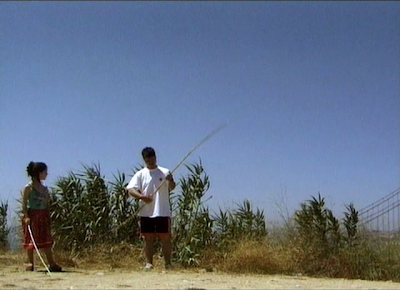
Rodrigues still manages to keep things relatively interesting, visually, by virtue of his camera placement.


After getting to know the family in their natural environment(s) — in France and Trás-os-Montes — we now get to see them in the role of "tourists". Because the subjects of the film are now, for the most part, passive (walking, watching, learning), this was never going to be as interesting as the first film was, and for that reason also, it is unsurprising to find that the best scenes are the ones in which they are "allowed" to fall back into familiar territory (a chance encounter between José and a fellow cobbler, and a devotion-filled visit to a religious giftshop).

Rodrigues still manages to keep things relatively interesting, visually, by virtue of his camera placement.


Saturday, December 22, 2012
Esta é a Minha Casa (João Pedro Rodrigues, 1997)
Esta é a Minha Casa, a documentary following a family of Portuguese emigrants in France, as they travel back home to Trás-os-Montes, finds João Pedro Rodrigues with one foot back on Ethnographic Film territory — registering behaviours, rituals, customs (something not completely absent from his feature films) — although the director's primary interest is clearly in the film as Cinema, showing an obvious effort to always find interesting angles from which to shoot the action, and editing it in a somewhat abstract, fragmented way, which seems counter-productive to the purpose of Ethnography.


The film is marvelously complemented by the ethnographic essay it originated, Filomena's Silvano's De Casa em Casa, which paints a more comprehensive picture of the human side of things, and gives context to the action in the film.


I found this footnote especially amusing:
Out of politeness, José never made any negative comments towards the films. He merely regretted the absence of some shots for which he had high expectations, (...) and asked for copies, if possible, of all the material we shot. He has, however, confided in his neighbor, a sociologist who put us in touch with him, expressing his perplexity at how the film was shot. The main issue was related to the fact that the classical cinematic representation focusing on the face, the part of the human body which in western culture is more directly associated with personal identity, was not the director's option of choice.
Sunday, November 25, 2012
Parabéns! (João Pedro Rodrigues, 1997)
On the morning of his 30th birthday, Chico wakes up to find a young man on his bed, with whom he spent the night. The film is a (re)collection of details of The Morning After.
Parabéns! is where João Pedro Rodrigues starts coming into his own, the first glimpse into the style and themes we've come to know from his features, albeit still in embryonic form.
The character of João is in a way a percursor to O Fantasma 's Sérgio, exhibiting the same kind of animalistic energy, although while the latter assumed a canine behaviour (barking, crotch-sniffing, territorial pissing), the former more clearly resembles a feline.
Of the details, the overlapping sounds of Tom Tom Club and Dragon Ball Z is something to cherish.
Parabéns! is where João Pedro Rodrigues starts coming into his own, the first glimpse into the style and themes we've come to know from his features, albeit still in embryonic form.
The character of João is in a way a percursor to O Fantasma 's Sérgio, exhibiting the same kind of animalistic energy, although while the latter assumed a canine behaviour (barking, crotch-sniffing, territorial pissing), the former more clearly resembles a feline.
 |
| Pawing. |
 |
| Pouncing. |
 |
| Sipping milk. |
Of the details, the overlapping sounds of Tom Tom Club and Dragon Ball Z is something to cherish.
Tuesday, November 13, 2012
O Pastor (João Pedro Rodrigues, 1988)
João Pedro Rodrigues' ESTC graduation short film.
Formally assured, and consisting mostly of long shots, it tells the story of a shepherd who, at the age of 65, is forced to retire. It is unsurprising to learn that António Reis was one of Rodrigues' teachers at ESTC, considering how much it reminded me of Reis' own semi-ethnographic portrayals of quotidian rural life in Trás-os-Montes and Ana. Still, it is a mere curiosity.
Subscribe to:
Posts (Atom)