Sunday, November 24, 2013

ABCs of Death 2 - Search for the 26th Director

The competition to find the 26th horror short to be included in ABCs of Death 2 produced a few gems, proving cinema is alive and well, thank you very much. 


M is for Masticate
M is for Masticate (Robert Boocheck, 2013)


M is for Meat
M is for Meat (Wolfgang Matzl, 2013)


M is for Meat
M is for Middle (Soichi Umezawa, 2013)


M is for Middle was not selected to be in the final 12, and as such, it won't be included in the collective film, but that's ok, because Soichi Umezawa has the brightest future of them all. What a doozy!

Sunday, September 1, 2013

Kick-heart (Masaaki Yuasa, 2013)

At the age of 48, Masaaki Yuasa creates with the unfettered imagination of a 5-year-old.

Bless him.


Masked Man M wrestler

Wrestling in Kick-heart

Lady S. in Kickheart

Sunday, August 4, 2013

Hayao Miyazaki

"Airplanes are the most beautiful when they are in the air. I wanted to see a Zero flown by a Japanese aviator, not an American. My fantasy was to see it flown under high-voltage power transmission cables next to Studio Ghibli in western Tokyo. But my wife told me to stop being such an idiot, and that was that."

Sunday, July 7, 2013

Shoes

Jerry Seinfeld and David Letterman in Comedians in Cars Getting Cofffee
David Letterman and Jerry Seinfeld in Comedians in Cars Getting Coffee 2.2 (2013)


Images of shoes in film are a rare thing. Feet rarely get a close-up of their own, and since the current aspect ratios are not made to accommodate the whole of the human figure, and the feet are the farthest away from the face (the part of the human body most closely associated with personal identity, and as such, the most prevalent in narrative filmmaking), it's unlikely that they will show in the frame accidentally.

Once in a while, however, feet do get a close-up of their own. That choice is worth noting.

Sunday, June 23, 2013

Johnnie To

"Most of the films are made for the industry, and to sustain my company. I can count on one hand the films I really enjoyed making:  The Mission, PTU, Exiled, Sparrow and Life Without Principle. That’s  just five! And the rest are, shall I say, business projects."

— Johnnie To


via The Hollywood Reporter

Sunday, June 16, 2013

La leggenda di Kaspar Hauser (Davide Manuli, 2012)

Silvia Calderoni in La leggenda di Kasper Hauser

Silvia Calderoni cuts an astonishing figure in Davide Manuli's La leggenda di Kaspar Hauser, her body constantly bouncing to a silent beat, as if her heart was a drum machine, a kinetic energy that is both awkward and awe-inspiring. A true messiah.

Sunday, June 2, 2013

Addicted to Love (Griffin Dunne, 1997)


A stunning moment in Griffin Dunne's Addicted to Love, a camera obscura projection of a window across the street, an ex-girlfriend turned object of desire, magically "lit up" by virtue of a brokenhearted man's misguided (but oh so earnest) fixation.

All romantic comedies should be this perverse.

Sunday, May 19, 2013

The Son of No One (Dito Montiel, 2011)

1986, Queensboro Projects

Queensbridge looks eerily beautiful from above. Strange-looking structures surrounded by trees, scattered around with no apparent criteria, as if they had sprouted from the earth, it almost looks like something from another world. 

Dito Montiel's cinema is essentially impressionistic. Recollections of moods, places, events, people. Always too richly detailed to have been entirely made up. In The Son of No One, when his camera repeatedly hovers over the neighborhood, it's as if these buildings are hiding a million different stories, and he knows every single one of them.


Queensboro Projects in The Son of No One

Queensbridge aerial view

Queensbridge night time

Wednesday, May 8, 2013

R.I.P. Ray Harryhausen

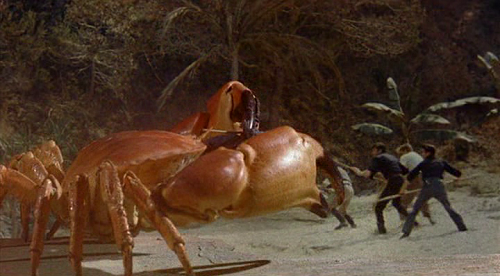
Ray Harryhausen's Giant Crab in Mysterious Island

Ray Harryhausen's Giant Bird in Mysterious Island

Ray Harryhausen's Giant Bee in Mysterious Island
Mysterious Island (Cy Enfield, 1961)


Ray Harryhausen's contribution to the art of cinema is ever more meaningful in an age where countless new films try (and fail) to convince me I should be in awe of their unbelievable (literally, not believable) CGI spectacles.

He has shown me things I might otherwise never have seen. For that, I will be forever grateful.


Wednesday, May 1, 2013

Veronica (Griffin Dunne, 2013)


Kieran Culkin in Veronica, Movie 43

Emma Stone in Veronica, Movie 43

Griffin Dunne's Veronica


Admittedly, the screenshots don't do justice to the tone of romantic despair that Kieran Culkin and Emma Stone convey so beautifully.

Griffin Dunne's Veronica is at odds with everything else in Movie 43. No irony, no faux-edginess; it's all heart. A real treat.

Sunday, April 28, 2013

Deadfall (Stefan Ruzowitzky, 2012)


Eric Bana in Deadfall


Deadfall is a classic example of a film that lives on the strenght of its director's virtuosity. Given a terrible script to work with, Stefan Ruzowitzky makes the most of it by focusing on the basics of each individual moment: how do you shoot a car crash? How do you shoot a murder? How do you shoot a sex scene? Taken as a whole, the film doesn't make a lot of sense, but moment to moment, it's beautifully realized.

Monday, March 11, 2013

Sunday, March 10, 2013

Flight (Robert Zemeckis, 2012)

I

Upside-down airplane in Flight


II 

Denzel Washington shedding a tear in Flight


III 

Hospital stairway conversation in Flight


IV

Vodka Bottle in Flight


V


Denzel Washington in Flight


Five great scenes from Robert Zemeckis' Flight, a film so packed with cliches and heavy symbolism that only at the hands of a master craftsman could it have turned out as good as it is. Zemeckis is the most modern of filmmakers working in the classical Hollywood mold.

Sunday, January 20, 2013

China, China (João Pedro Rodrigues e João Rui Guerra da Mata, 2007)

Trapped in a life she doesn't want, China finds her freedom in small moments of bliss she invents for herself, and in those moments, China, China comes alive like few other movies do.

This scene, a 3-second handrail slide that's made to last 10 seconds — because that's how long it takes to really appreciate it — is probably my favorite in all of João Pedro Rodrigues' work.


Sunday, December 23, 2012

Viagem à Expo (João Pedro Rodrigues, 1998)

Viagem à Expo is a sort of follow-up to Esta é a Minha Casa, this time following the Fundo family on a trip to Lisbon, to visit the 1998 Lisbon World Exposition (Expo '98).

After getting to know the family in their natural environment(s) — in France and Trás-os-Montes — we now get to see them in the role of "tourists". Because the subjects of the film are now, for the most part, passive (walking, watching, learning), this was never going to be as interesting as the first film was, and for that reason also, it is unsurprising to find that the best scenes are the ones in which they are "allowed" to fall back into familiar territory (a chance encounter between José and a fellow cobbler, and a devotion-filled visit to a religious giftshop).


José meets a fellow cobbler in "Viagem à Expo"


Rodrigues still manages to keep things relatively interesting, visually, by virtue of his camera placement.


Tejo view in Viagem à Expo

Cristo Rei in Viagem à Expo

Ponte 25 de Abril in Viagem à Expo

Saturday, December 22, 2012

Esta é a Minha Casa (João Pedro Rodrigues, 1997)

Esta é a Minha Casa, a documentary following a family of Portuguese emigrants in France, as they travel back home to Trás-os-Montes, finds João Pedro Rodrigues with one foot back on Ethnographic Film territory — registering behaviours, rituals, customs (something not completely absent from his feature films) — although the director's primary interest is clearly in the film as Cinema, showing an obvious effort to always find interesting angles from which to shoot the action, and editing it in a somewhat abstract, fragmented way, which seems counter-productive to the purpose of Ethnography.


Esta é a Minha Casa, João Pedro Rodrigues

José in a chapel in Esta é a Minha Casa

Religious procession in Esta é a Minha Casa


The film is marvelously complemented by the ethnographic essay it originated, Filomena's Silvano's De Casa em Casa, which paints a more comprehensive picture of the human side of things, and gives context to the action in the film.


Filomena Silvano's De Casa em Casa


I found this footnote especially amusing:

Out of politeness, José never made any negative comments towards the films. He merely regretted the absence of some shots for which he had high expectations, (...) and asked for copies, if possible, of all the material we shot. He has, however, confided in his neighbor, a sociologist who put us in touch with him, expressing his perplexity at how the film was shot. The main issue was related to the fact that the classical cinematic representation focusing on the face, the part of the human body which in western culture is more directly associated with personal identity, was not the director's option of choice.  

Sunday, November 25, 2012

Parabéns! (João Pedro Rodrigues, 1997)

On the morning of his 30th birthday, Chico wakes up to find a young man on his bed, with whom he spent the night. The film is a (re)collection of details of The Morning After.

Parabéns! is where João Pedro Rodrigues starts coming into his own, the first glimpse into the style and themes we've come to know from his features, albeit still in embryonic form.

The character of João is in a way a percursor to O Fantasma 's Sérgio, exhibiting the same kind of animalistic energy, although while the latter assumed a canine behaviour (barking, crotch-sniffing, territorial pissing), the former more clearly resembles a feline.


Pawing
Pawing.

pouncing
Pouncing.

sipping milk
Sipping milk.


Of the details, the overlapping sounds of Tom Tom Club and Dragon Ball Z is something to cherish.

Tuesday, November 13, 2012

O Pastor (João Pedro Rodrigues, 1988)

João Pedro Rodrigues' ESTC graduation short film.

Formally assured, and consisting mostly of long shots, it tells the story of a shepherd who, at the age of 65, is forced to retire. It is unsurprising to learn that António Reis was one of Rodrigues' teachers at ESTC, considering how much it reminded me of Reis' own semi-ethnographic portrayals of quotidian rural life in Trás-os-Montes and Ana. Still, it is a mere curiosity.